
Monitoring is the product. Everything else is hardware.
You can buy a siren at a big-box store for ninety dollars. What you cannot buy there is a human being in a chair at 3:14 on a Tuesday morning whose only job, at that moment, is your house.
Fixed written quote after a free survey — we beat any written competitor quote
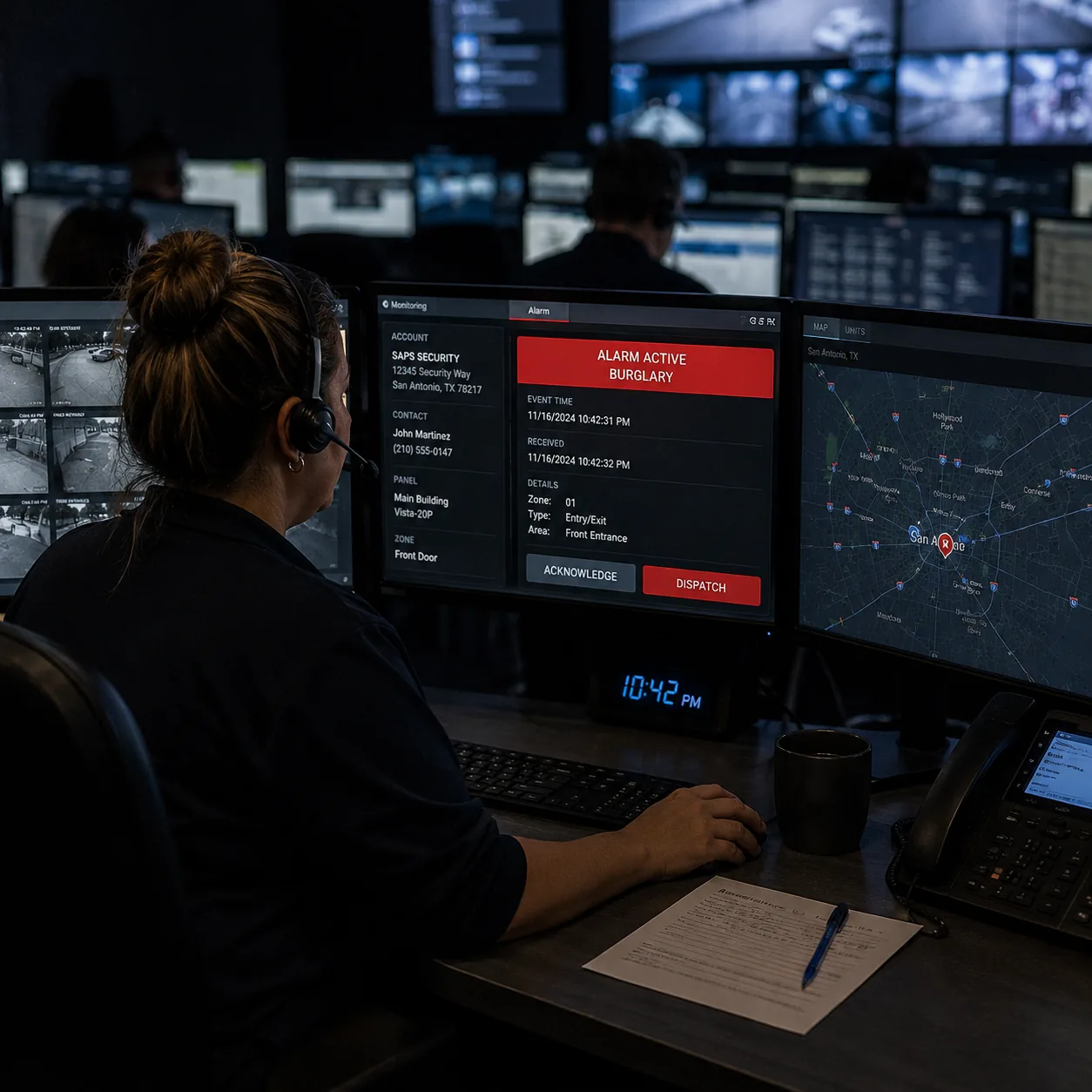
What happens in the fifteen seconds after a sensor trips
Your panel detects the fault and transmits over encrypted cellular. That signal lands at a UL-listed, redundant central station — two geographically separate facilities, either of which can carry the full load if the other loses power, connectivity or a roof. Within about fifteen seconds a licensed operator has your account open on screen: your address, your gate code, your dog's name, the fact that your mother-in-law stays in the guest room and does not know the code.
They call. If the passcode is wrong or nobody answers, they dispatch — and they dispatch to the correct agency, which in a metro with as many overlapping jurisdictions as Bexar County is a genuine skill. Then they call your emergency contacts in the order you specified, not the order a database happened to store them.
That sequence is the entire value proposition. Everything else in this industry is a delivery mechanism for those fifteen seconds.
Why our rate is lower and how that is possible
We are asked this constantly, usually with a note of suspicion, and the answer is boring. We do not run Super Bowl advertising. We do not pay a door-to-door channel a four-figure bounty per activation. We do not carry the overhead of a national brand that has to service acquisition debt from buying up smaller alarm companies.
What is left after you remove those costs is the actual price of monitoring an account: the central station contract, the signaling, the licensing, the insurance, and the technician. That number is smaller than the industry has trained you to expect, and we pass it through. If you have a written quote from anybody else, bring it. We will beat it on comparable scope, in writing, and we will show you line by line where their number goes.
What a five-year agreement should buy you
Our standard term is sixty months. That is the industry norm rather than a differentiator, and we state it plainly instead of burying it on page four of a document you sign at your kitchen table.
The industry standard is a 36 or 60-month agreement with an auto-renewal clause and an early termination fee calculated as the balance of remaining payments. That structure exists for exactly one reason: it lets a company keep billing customers who no longer want the service. It is a business model that profits from inertia and confusion, and it is why the alarm industry has the customer satisfaction reputation it has.
What should differ over five years is the service, and that is where we compete: every service call free, no trip charge at any distance, a local number answered by someone who can open your account, and technicians who average seven years with us rather than seven months.
What is included
- UL-listed redundant central stationTwo geographically separate facilities, either able to carry full load.
- ~15-second average responseFrom signal receipt to a licensed operator with your account open.
- Encrypted cellular signalingIndependent of your phone line and your internet connection.
- Local technicians who stayW-2 employees averaging seven years here — often the same person who installed it.
- We beat any written quoteAny licensed competitor, comparable scope, in writing — bring it to us.
- Free service callsIncluded for monitored accounts. No trip charge, no diagnostic fee.
Questions people actually ask
- Is your central station UL-listed? +
- Yes, and redundant across two geographically separate facilities. That redundancy is what keeps monitoring live through regional events — hurricanes on the Gulf, the February 2021 freeze, extended grid failures.
- How long is the monitoring agreement? +
- Sixty months, which is the same commitment most national brands ask for. We do not think the length is what separates providers — five years is long enough that the service is what you will actually remember. Ours includes free service calls for the life of the account, a San Antonio office that answers the phone, and the rate-beat guarantee on any written competitor quote.
- What if I already have a system from another company? +
- We can usually take it over. Most panels installed in the last fifteen years can be reprogrammed to our central station in about an hour. See our takeover service for details.
- What happens on a false alarm? +
- The operator calls first and verifies with your passcode. If it is a false trip you say so, they log it, nothing is dispatched. Most municipalities in Texas assess false-alarm fines after a threshold, so we also audit repeat trips and fix the underlying sensor at no charge.
24/7 Alarm Monitoring across Texas
We install and service this in all four metros, and in every community within fifty miles of downtown San Antonio. Service calls carry no trip charge regardless of how far out the address is.
Free survey · No obligation
Bring us a written quote. We will beat it.
Any competitor, comparable scope, in writing. A licensed technician walks your property, maps the real entry points and gives you a fixed number — whether or not you hire us.
TX DPS PSB Lic. #B16898 · Serving San Antonio, Austin, Houston & Dallas since 2010