
Statistically, the thing that ruins your house is water
Homeowners buy alarm systems because of burglars. Homeowners file claims because of pipes. There is a lesson in that gap, and the insurance industry learned it a long time before the alarm industry started mentioning it.
Fixed written quote after a free survey — we beat any written competitor quote
The February lesson
In February 2021, Texas learned what happens when supply lines in an uninsulated attic freeze, thaw, and let go into a house nobody is standing in. The damage was not usually the freeze. It was the eleven hours between the pipe splitting and somebody walking in the door.
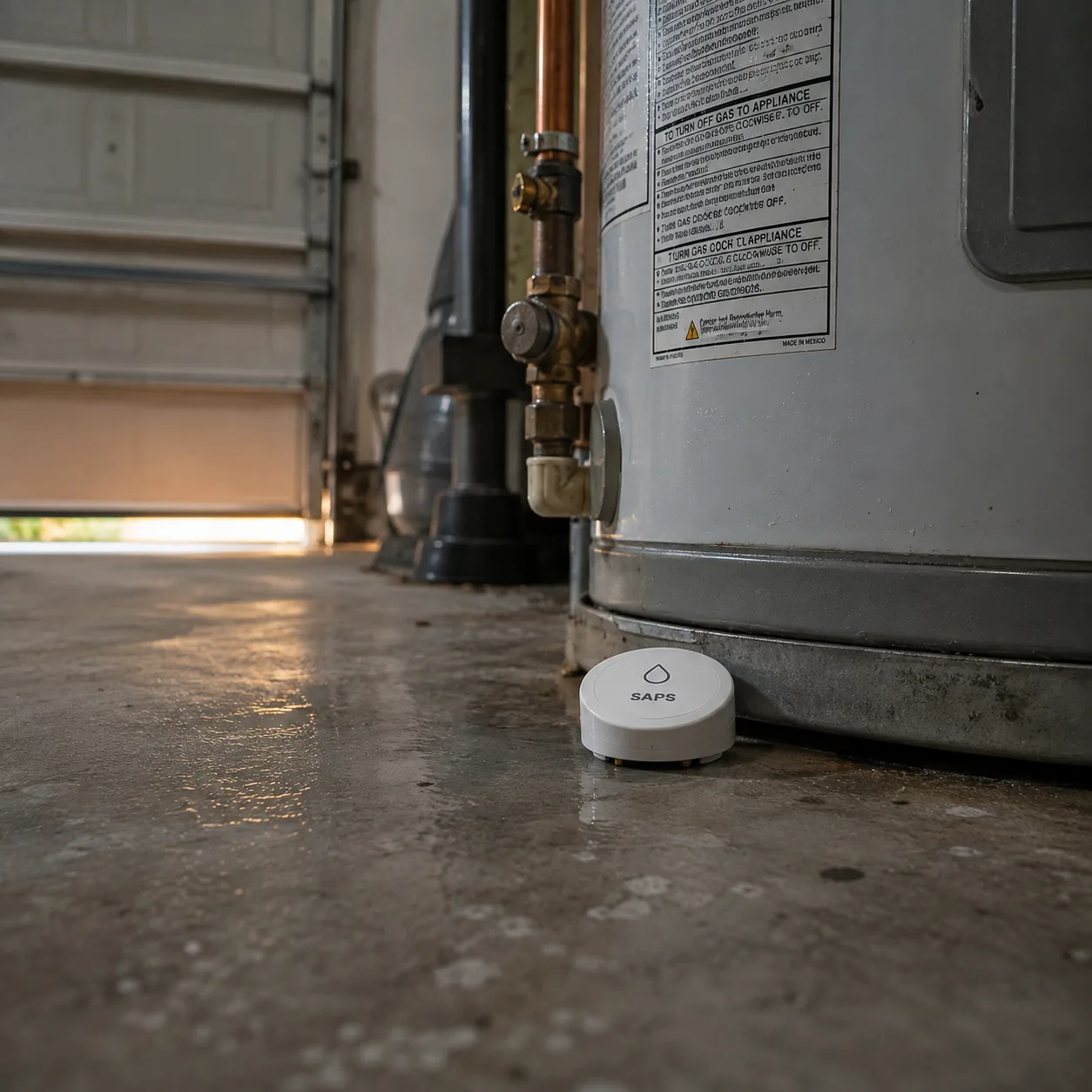
A monitored water sensor costs about the price of a decent dinner and sits on the floor next to the water heater, under the kitchen sink, behind the washer, and at the attic air handler pan. When it gets wet, the central station calls you. Eleven hours becomes four minutes. If you add an automatic shutoff valve, it becomes zero, because the main closes itself and the flooding simply stops.
Monitored smoke is not the same as a smoke detector
The detector you bought at the hardware store protects people who are home and awake enough to hear it. That is genuinely valuable and you should have them. But it does nothing at all for a house that is empty — and a kitchen fire that starts at 10 a.m. in an empty house is the one that takes the whole structure.
Monitored smoke and heat detectors transmit to the central station, which dispatches the fire department whether or not anyone is home to hear the horn. In a two-story house with an attached garage, that difference is measured in rooms.
Carbon monoxide is the one nobody thinks about in a warm climate, and it should be. Gas water heaters, gas ranges, gas furnaces on the handful of genuinely cold Texas nights, and — the recurring tragedy — generators run too close to the house during an outage. CO is odorless. It does not wake you up. It makes you sleep more deeply. A monitored CO detector is the only thing in your house that will argue with it.
It frequently pays for itself
Most homeowners insurance carriers writing in Texas discount premiums for a monitored alarm, and many discount further for monitored fire and water. The range we see is roughly 5 to 20 percent on the dwelling portion. We provide the certificate your carrier needs, signed and dated, and we will email it directly to your agent if you would rather not chase it.
Run the arithmetic on your own declarations page. On a fair number of policies in this market, the annual discount lands close to the annual cost of monitoring, which makes the security itself effectively a rounding error. We are aware of how that sounds coming from us, which is precisely why we suggest you check it yourself rather than take our word.
What is included
- Monitored smoke and heatFire department dispatched even when the house is empty.
- Carbon monoxide detectionThe hazard that has no smell and no warning sign.
- Water leak sensorsWater heater, sinks, washer, attic air handler pan — the four usual suspects.
- Automatic shutoff valveOptional. Closes the main on detection so the flooding simply ends.
- Freeze detectionLow-temperature alerts before the pipes in the attic reach the failure point.
- Insurance certificateIssued and emailed to your agent for the premium credit.
Questions people actually ask
- Will this lower my homeowners insurance? +
- In most cases, yes. Carriers writing in Texas commonly credit 5 to 20 percent for monitored alarm, fire and water detection. We issue the certificate; your agent applies the credit.
- How many water sensors do I need? +
- Four covers most homes: water heater, under the kitchen sink, behind the washing machine, and the attic air handler drain pan. Add one per additional bathroom on a second floor.
- Do the monitored smoke detectors replace my existing ones? +
- They supplement them. Code requires interconnected smoke alarms in sleeping areas; monitored detectors add central station dispatch on top. We do not remove anything required by code.
Smoke, CO & Water Monitoring across Texas
We install and service this in all four metros, and in every community within fifty miles of downtown San Antonio. Service calls carry no trip charge regardless of how far out the address is.
Free survey · No obligation
Bring us a written quote. We will beat it.
Any competitor, comparable scope, in writing. A licensed technician walks your property, maps the real entry points and gives you a fixed number — whether or not you hire us.
TX DPS PSB Lic. #B16898 · Serving San Antonio, Austin, Houston & Dallas since 2010