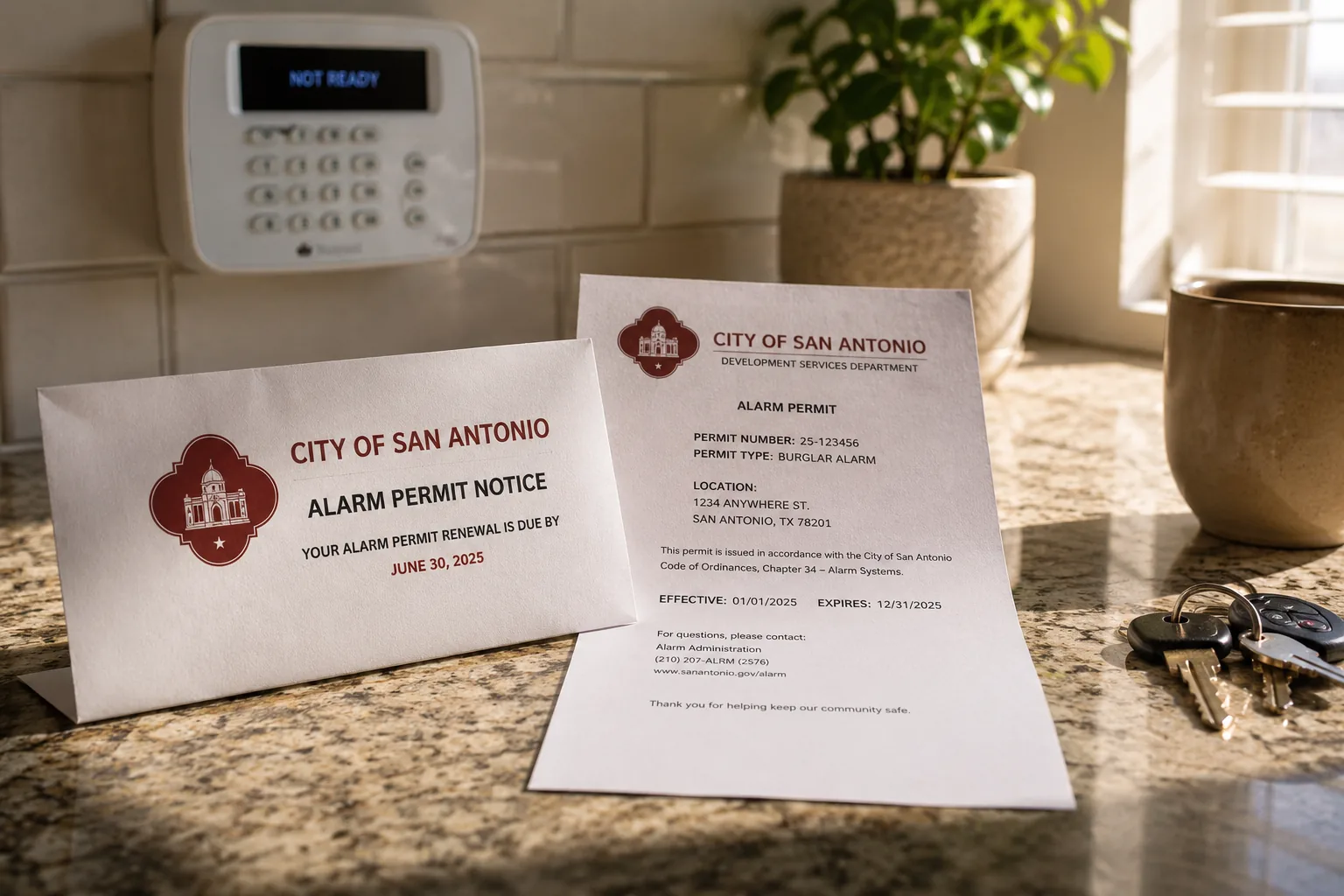
Here is the short version, and if you read nothing else, read this: San Antonio requires a permit for a monitored alarm system, the permit is inexpensive, and operating without one is more expensive than having one. Repeat false alarms carry escalating fines, and after enough of them the police response you are paying for stops arriving.
That last consequence is the one that matters. Every other cost is money. This one is the actual product.
Why cities fine false alarms at all
It is worth understanding the municipal position, because it is not unreasonable. A patrol unit dispatched to an alarm call is a patrol unit not available for anything else. Nationally, the overwhelming majority of burglar alarm dispatches — commonly cited in the range of 94 to 98 percent — turn out to be false. In a city the size of San Antonio, that adds up to a substantial number of officer-hours per year spent driving to houses where a balloon drifted past a motion detector.
Cities responded with ordinances. The structure is nearly universal across Texas: register your system, get a small number of free false alarms per year as grace, then pay escalating fines, and eventually lose response privileges entirely until the account is brought back into good standing.
How the San Antonio structure works
San Antonio administers residential and commercial alarm permits through the city, renewed annually. The permit ties your address to a responsible party and a set of contacts, and it is what the responding agency checks when a dispatch comes in.
| Stage | What happens | Practical consequence |
|---|---|---|
| No permit on file | Fine assessed per response, often at a higher rate | You pay more for every single dispatch |
| Permit + first few false alarms | Warning letters, no charge | Free grace period — use it to fix the cause |
| Beyond the allowance | Escalating per-incident fines | Cost climbs with each additional event |
| Chronic false alarms | Permit suspension or revocation | Police may stop responding to your alarms |
Austin, Houston and Dallas each run their own version with different numbers, different renewal cycles and different appeal processes. If you own property in more than one of those metros, they do not talk to each other and you will need a permit in each. We handle permit paperwork for our monitored customers because it is genuinely tedious and because an unpermitted account is a bad outcome we would rather prevent than explain.
What actually causes false alarms
Almost nothing on this list is mysterious, and almost every item is permanently fixable in a single service visit. That is the important thing to understand: a chronic false alarm is a defect, not a personality trait of your system.
User error, which is not really the user's fault
The largest category, and it is overwhelmingly a design problem masquerading as a human one. Entry delays set too short for a person carrying groceries from a detached garage. A keypad mounted where you have to walk past a motion detector to reach it. Codes that were never issued to the housekeeper, so the housekeeper trips it every other Thursday. A system so unpleasant to operate that half the household stopped arming it, which produces zero false alarms and zero security.
Fixing these means changing the system, not lecturing the family. Longer entry delay. Keypad relocated. A code for every person who has legitimate access. It takes an hour.
Environment, which is specific to Texas
- Afternoon sun crossing a west-facing window into the field of a motion detector — a genuine daily event from May through September here.
- HVAC vents blowing directly across a sensor. Moving air moves curtains, plants and hanging decorations, and passive infrared reads a rapidly moving temperature differential as a person.
- Ceiling fans, especially with a slight wobble, and especially in a room with a west window.
- Mylar balloons. A birthday party can generate three days of false alarms and it is one of the most common causes we find.
- Doors and windows that fit in February and swell shut differently in August, opening a gap at a contact.
- Glass-break detectors within earshot of a granite counter, a dropped keyring, a barking dog, or the specific frequency of certain smoke alarm chirps.
Pets, which are worth their own paragraph
Pet-immune motion detectors are rated by weight — commonly 40 or 80 pounds — and the rating assumes correct mounting height and angle. Install an 80-pound-rated sensor too low and a 60-pound dog will trip it reliably. More to the point, the rating assumes the animal stays on the floor. A cat on a bookshelf, or a dog that has learned to get onto the back of the sofa, is at human height as far as the sensor is concerned, and no amount of pet immunity accounts for that.
The fix is geometry: mount higher, angle to create a detection field above the animal's normal range, and use door and window contacts as the primary interior-perimeter layer so motion detection is doing less of the work in the first place.
Equipment reaching the end of its life
Wireless sensor batteries fade before they fail, and a fading sensor transmits erratically — which the panel may report as a fault rather than a low battery. Panel backup batteries last three to five years. Smoke detectors have a hard manufacturer end-of-life, usually ten years, after which the sensing chamber becomes unreliable in both directions. A ten-year-old smoke detector that falses at 3 a.m. is not being dramatic; it is telling you something true about itself.
Verified response, and why it changes the math
A growing number of Texas jurisdictions treat verified alarms differently from unverified ones. A verified alarm is one where the monitoring center has independent confirmation that something is genuinely happening — video showing a person on the property, audio from the premises, or a second independent sensor tripping in a pattern consistent with movement through the structure.
Verified alarms get prioritized. Unverified alarms, in some jurisdictions and under some conditions, get deprioritized or handled on a call-back basis. That distinction is the strongest practical argument for adding video verification to an alarm system, particularly for properties in unincorporated areas served by a county sheriff over a large geography — Timberwood Park, Canyon Lake, rural Wilson and Medina County. When the responding unit may be fifteen minutes out, the difference between "zone fault" and "there is a person at the back door right now" is the difference between a routine call and an urgent one.
Every false alarm you send is a small withdrawal from the credibility of the next real one. Fix the false ones so the real one gets taken seriously.
A short, complete action list
- 1Confirm you hold a current alarm permit for every address you monitor, in every city where you own property.
- 2Verify the contact list at your monitoring center is accurate — names, numbers and passcodes, with anyone who moved away removed.
- 3Issue a unique code to every person with legitimate access, including cleaners, sitters and contractors, and delete codes for people who no longer need them.
- 4Ask for your entry delay to be lengthened if you have ever run for the keypad. That is a setting, not a fact of life.
- 5Have any sensor that has falsed more than twice diagnosed rather than bypassed. A bypassed zone is an unprotected opening you will forget about.
- 6Replace smoke detectors at their manufacturer end-of-life date, which is printed on the back of the unit.
- 7Consider video verification if you are outside city limits or your response agency covers a large area.
None of that is expensive and all of it is boring, which is why it goes undone in most households until a letter arrives. It takes one visit. For our monitored customers it takes one phone call and costs nothing, because the alternative — a customer whose alarm system is being ignored by both the city and the family that owns it — is worse for everyone, including us.
Quick answers
- Do I need an alarm permit in San Antonio? +
- Yes. The City of San Antonio requires a permit for monitored alarm systems at residential and commercial addresses, renewed annually. Responding to an alarm at an unpermitted address typically carries a higher per-incident charge than at a permitted one.
- How much are false alarm fines in San Antonio? +
- Fines escalate with each incident beyond an annual free allowance, and chronic false alarms can result in permit suspension — after which police may decline to respond. Because the ordinance schedule is revised periodically, confirm current amounts with the city alarm office before relying on any published figure.
- What is the most common cause of false alarms? +
- User-related trips driven by system design — entry delays that are too short, keypads placed badly, and missing codes for people with legitimate access. Environmental causes come second, led in Texas by afternoon sun through west-facing windows and HVAC airflow moving objects within a motion detector's field.
- Will police stop responding to my alarm? +
- In most Texas jurisdictions, yes, after enough false alarms to trigger permit suspension or revocation. This is why chronic false alarms should be treated as an equipment or design defect to be repaired rather than an annoyance to be tolerated.