We want to be careful here, because it would be easy to write this piece as an attack and easy to dismiss it as one. Long-term alarm agreements are legal, they are disclosed, and there are customers for whom they represent a genuinely reasonable trade. If you have no cash for equipment and you want a system installed on Thursday, financing that hardware over five years is a defensible decision.
What we object to is not the existence of the contract — ours runs sixty months too. It is that the contract is presented as a formality and the arithmetic is never performed out loud. So let us perform it.
The arithmetic, done once, in public
Take a standard national-brand residential offer. Free equipment package. Free installation, or $99. Monitoring at $54.99 per month. Sixty-month term. It sounds like the sort of thing you sign and stop thinking about, which is precisely the design intent.
| National brand, 60-month term | SAPS, 60-month term | |
|---|---|---|
| Equipment | "Free" (leased, returned on cancel) | Owned outright — one fixed written quote |
| Installation | $99 | Included |
| Monitoring | $54.99 / mo | Beats any written competitor quote |
| Service calls (est. 4 over 5 yrs) | $149 each = $596 | $0 |
| You own the equipment after | No — return it | Yes, from day one |
| Who answers in year four | National call center | San Antonio office |
Run your own totals and the five-year figures land closer than you might expect, which is the honest version of this story. Where the two paths genuinely diverge is at the end. In one, you have spent thousands and own nothing; the hardware goes back in a box, and if you decline to return it you are billed for it. In the other, the system on your wall is your property.
And at the end of the term, the second path leaves you owning the hardware on your wall — which is the difference that decides how much leaving actually costs.
The auto-renewal clause
This is the part that deserves your full attention, and it is invariably the part in the smallest type.
Most long-term monitoring agreements renew automatically. Not for another sixty months, usually — the common structure is a rolling twelve-month or month-to-month renewal, and some agreements do renew for a full additional multi-year term. The renewal happens unless you deliver written notice of cancellation within a specific window, typically thirty to sixty days before the term expires. Miss the window by a week and you have agreed to another year.
The clause is not hidden, exactly. It is disclosed, initialed, and legally sound. It simply relies on the near-certainty that a person who signed something in 2021 will not think about paragraph fourteen in 2026. That is not a defect in the contract. That is the contract working as designed.
What "free equipment" is actually doing
Free equipment is a financing instrument, and it does two things at once. First, it moves the cost of hardware out of a number you would compare against competitors and into a number you have already agreed to pay regardless. Second, and more consequentially, it changes who owns the system in your walls.
Leased equipment cannot be taken over by another company. That is the whole point. When the contract ends and you want to switch, you are not switching monitoring providers — you are starting over, because the panel, the sensors and the communicator go back in a box. The cost of leaving is not the termination fee. It is the second installation.
Ask one question before you sign anything: after the final payment, who owns the panel on my wall? If the answer requires more than one sentence, you have learned something.
We sell equipment outright and we are aware this makes our first invoice larger and our sales conversations harder. It also means that when a customer leaves us — and customers do leave, for perfectly good reasons — they keep what they paid for and the next company can adopt it in an afternoon. We think that is how it ought to work. It is also, not coincidentally, why we spend nothing on retention pressure.
The door-to-door season
Every summer, roughly May through August, crews arrive in Texas neighborhoods on temporary licensing and work them hard. Dallas gets the heaviest volume; San Antonio, Austin and Houston all get their share. The pitch varies but the structure does not: urgency, a neighborhood angle, a limited-time framing, and a tablet already open to a signature screen.
- "We just installed your neighbor down the street" — verifiable, and worth verifying.
- "There’s been a string of break-ins in this subdivision" — ask which street, then check the SAPD or local PD blotter yourself.
- "This promotional pricing is only good today" — no legitimate security company prices on a same-day deadline.
- "We’re just upgrading your existing system" — a genuinely common misrepresentation. Never let anyone touch an existing panel without confirming in writing which company they work for and what happens to your current account.
- "You don’t need to read that part, it’s standard" — the single most expensive sentence in the industry.
Texas law is on your side here in a way most people do not know: a contract signed at your home, rather than at a place of business, generally carries a three-day right of cancellation. Written notice, delivered inside three business days, unwinds it. If you signed something on a porch last night and you have a bad feeling this morning, that feeling has a deadline and the deadline has not passed yet.
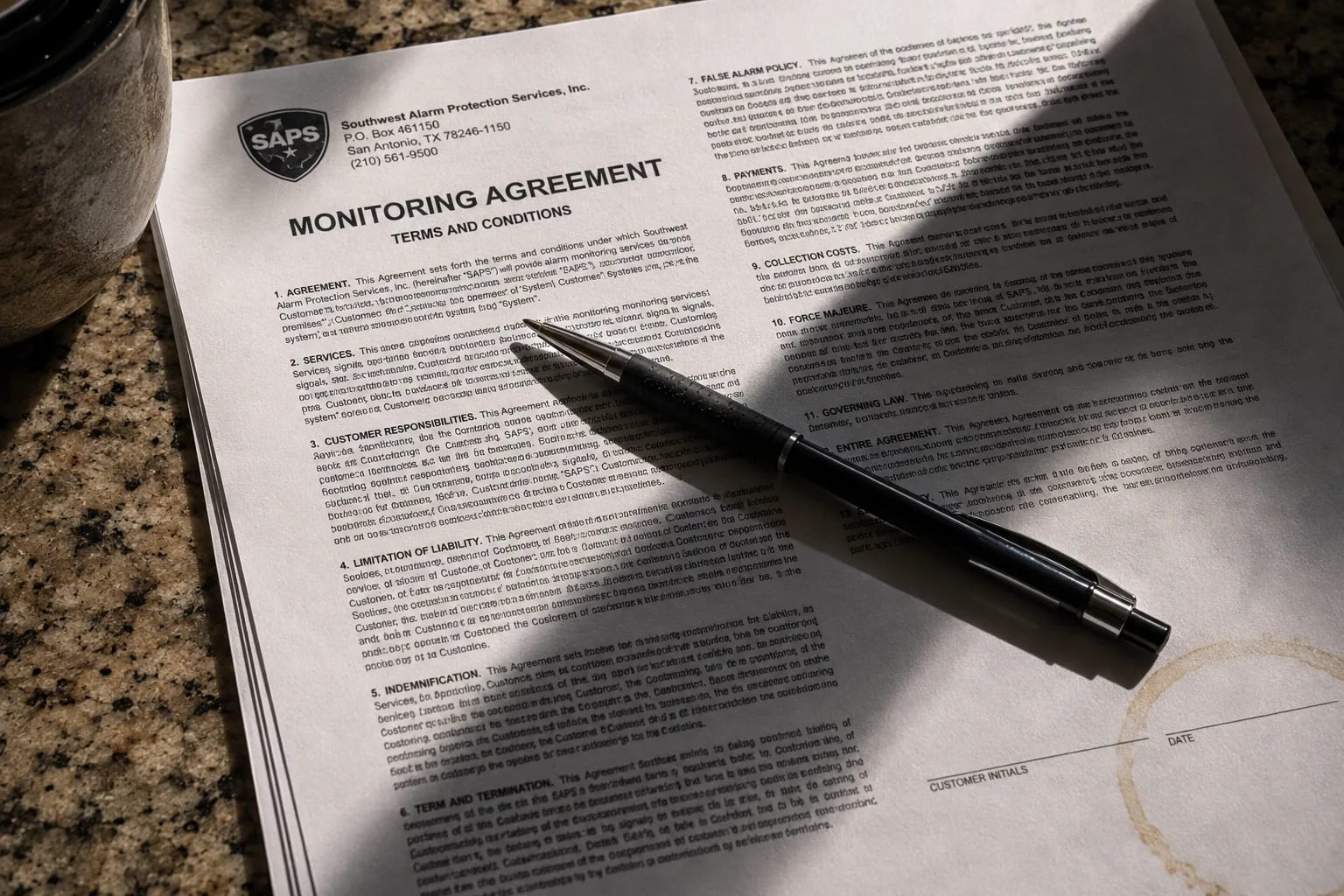
How to read your own agreement in eleven minutes
- 1Find the term length. Look for "initial term," measured in months. Sixty is common. Thirty-six is common.
- 2Find the renewal clause. Note the notice window and the required delivery method — many require written notice, and some specify certified mail.
- 3Find the early termination provision. Most calculate the fee as 75% to 100% of the remaining monthly payments. Multiply it out for month 24 so the number is real to you.
- 4Find the equipment ownership language. "Lease," "loaned," "remains the property of" and "must be returned" all mean the same thing.
- 5Find the price escalation clause. Many agreements permit an annual increase, frequently up to 5% or tied to an index, without renegotiation.
- 6Find the service and repair terms. Ask specifically what a truck roll costs after the warranty period, and get the number in writing.
- 7Find the assignment clause. Nearly all agreements permit the company to sell your account to another company. This is how customers end up monitored by a firm they never chose.
That last one explains a great deal of the frustration people carry into our first conversation. They signed with a local company they liked, and two years later the invoice came from a name they had never heard, with a support number that routes to a queue. The account was sold. The agreement permitted it. Nothing improper happened, and the customer still feels — correctly — that the thing they bought is not the thing they have.
Where we stand, stated plainly
It would be convenient to end this by telling you we are different because we do not ask for a term. We are not going to do that. Our own monitoring agreements run sixty months, the same length as most of the industry, and like everyone else we review rates annually. If you have read this far, you deserve that stated flatly rather than buried.
What we would argue is that the term is the wrong thing to shop on, because almost everyone worth hiring asks for one. What varies enormously — and what you will actually live with for five years — is what happens after the install. Whether a service call costs you two hundred dollars or nothing. Whether the number on the invoice reaches a person who can open your account or a queue in another state. Whether the technician who comes out has been with the company longer than your system has.
So use the eleven-minute checklist above on us too. Ask what a service call costs — ours are free, at any distance, for the life of the account. Ask who answers the phone in year four. Ask to see the agreement before the day you sign it, and watch how quickly the answer comes. A company that is comfortable with those questions is telling you something a contract length never will.
Quick answers
- How much does a five-year alarm contract actually cost? +
- At a typical national rate of $54.99 per month, sixty months of monitoring alone is $3,299.40, before installation fees, service call charges and any contractual price escalation. The equipment described as free remains the property of the provider and must be returned when the agreement ends.
- Can I cancel an alarm contract I signed at my door? +
- In Texas, contracts signed at your residence rather than at a place of business generally carry a three-business-day right of cancellation. Deliver written notice within that window and keep proof of delivery. After three days, the standard early-termination provisions of the agreement apply.
- What is an auto-renewal clause in a monitoring agreement? +
- A provision that automatically extends your agreement at the end of the initial term unless you deliver written cancellation notice inside a defined window, typically thirty to sixty days before expiration. Missing the window commits you to the renewal period.
- Do I own the equipment on a no-contract plan? +
- With us, yes — equipment is purchased outright and belongs to you from installation day, which means any qualified company can take it over later. Under most leased-equipment agreements, the hardware remains the provider’s property and must be returned on cancellation.