The homeowner's first theory is always Wi-Fi. It is a reasonable theory. It is also wrong roughly eighty percent of the time in houses built before about 1995, and chasing it can burn a genuinely impressive number of weekends — mesh nodes, extenders, channel changes, a router replaced for no reason, three separate conversations with a support representative who has never been to Texas.
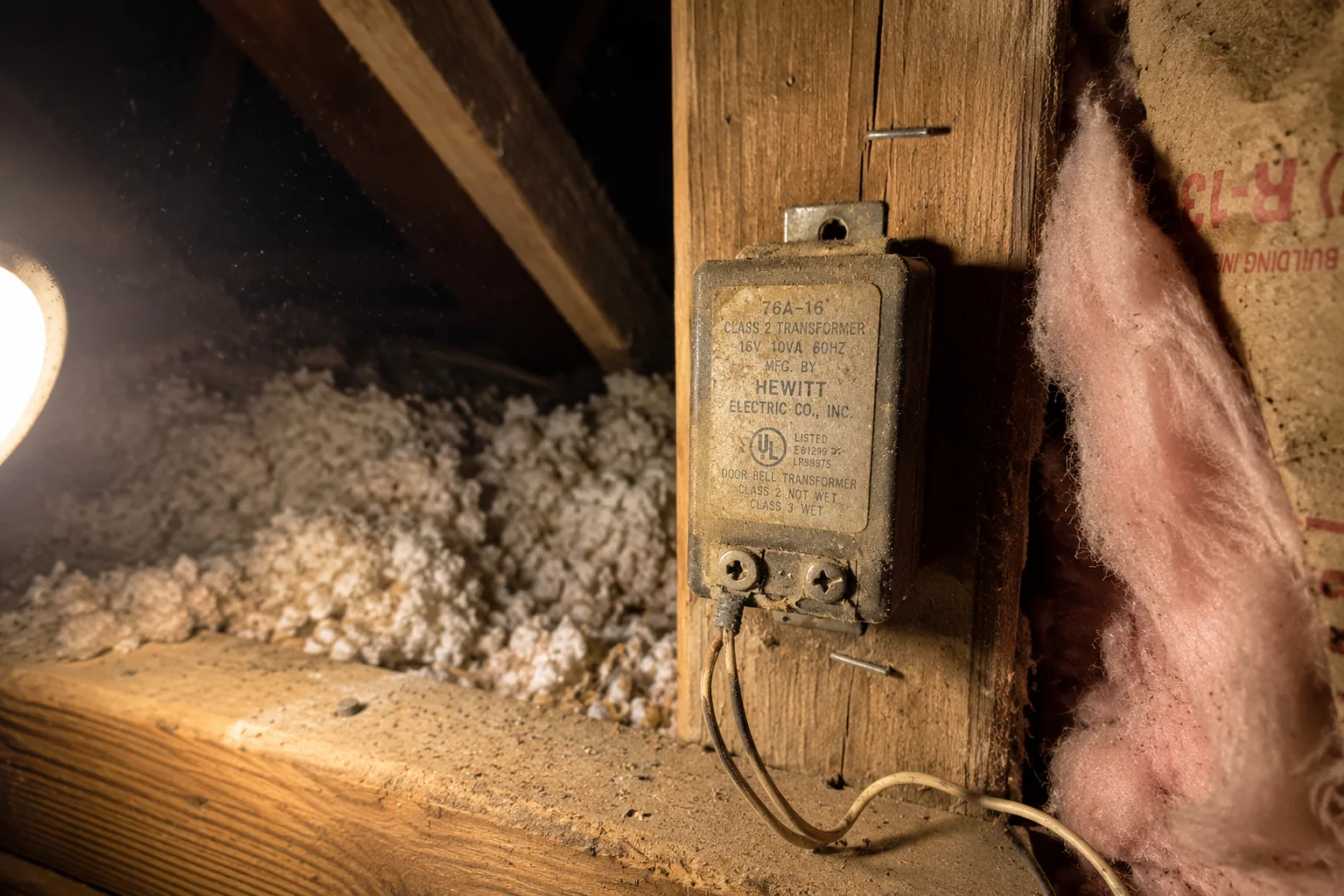
The problem is not in your router. It is stapled to a joist in your attic, it was installed during the Reagan administration, and it is doing exactly what it was designed to do, which is ring a mechanical bell.
What a doorbell transformer was built for
A traditional doorbell is one of the simplest circuits in a house. Press a button, complete a circuit, energize a solenoid, a plunger strikes two metal tubes, you hear a chime. The whole event lasts under a second and happens a few times a day.
The transformer feeding it was specified for that duty and nothing else. In most Texas homes built between roughly 1960 and 1995, that means 8 to 10 volts AC at 5 to 10 volt-amps. It is a tiny, cheap, extraordinarily reliable component that has been sitting in a 140-degree attic for four decades doing a job that requires almost no power.
Then somebody bolts a networked computer with a camera, a microphone, a speaker, a motion sensor and a Wi-Fi radio onto the end of it and asks it to run continuously, forever.
| Typical legacy transformer | Modern video doorbell requirement | |
|---|---|---|
| Voltage | 8–10 V AC | 16–24 V AC |
| Power | 5–10 VA | 20–40 VA |
| Duty cycle | A fraction of a second, a few times daily | Continuous, 24/7 |
| Peak draw | Solenoid strike only | Recording + Wi-Fi transmit + IR simultaneously |
Why it works — until it matters
This is the part that makes the problem so maddening to diagnose. An undersized transformer does not fail. It powers the device. The light comes on, the app connects, the setup wizard congratulates you, and for a week or so everything appears fine.
The failure only appears at peak draw. Idle, a video doorbell sips power. But the instant it needs to record, transmit video over Wi-Fi, and fire its infrared or floodlight simultaneously — which is to say, the exact instant something happens — demand spikes. The undersized transformer cannot hold voltage. The device browns out and reboots.
That reboot takes twenty to forty seconds, and it happens after the recording began. Which is precisely why the clip always ends at the moment of interest: the moment of interest is the moment of peak demand. The device is not being coy. It is fainting.
How to check yours in five minutes
You need a multimeter, which costs less than a pizza, and a willingness to go into an attic. In San Antonio, do this in February. We are entirely serious about that.
- 1Kill the breaker feeding the transformer. It is often on a general lighting circuit and is almost never labeled "doorbell," which is its own small adventure.
- 2Locate the transformer. Common spots: attic near the ceiling junction above the front door, inside the furnace or air handler closet, in the garage near the panel, or occasionally behind the chime cover itself.
- 3Read the label. It will state voltage and VA — for example, "16V 10VA." That is the rating. Photograph it.
- 4Restore power and measure across the two terminals with the meter on AC volts. A reading meaningfully below the rated voltage means the transformer is tired, not merely small.
- 5Compare against your device's requirement. Most modern video doorbells want 16–24 V AC at 30 VA or better. If your reading is 8 or 10 volts, you have found your problem and you can stop replacing routers.
Fixing it properly
The correct repair is replacing the transformer with a 16 V, 30 VA unit. The part costs about twenty dollars. The labor is finding it, getting to it, cutting power, swapping two low-voltage leads and two line-voltage leads, and confirming the chime still works afterward. Half an hour, most houses.
A common shortcut — the plug-in power adapter with a long wire running to the doorbell — works electrically and looks terrible, because there is now a visible cord running out of a hole near your front door. We install those only when there is genuinely no accessible transformer, and we say so before we do it rather than after.
The other frequent complication is the chime itself. Some mechanical chimes need a diode or a bypass module when a video doorbell is added, or they buzz continuously, or they refuse to ring at all. That is a known, solved, five-dollar problem, and it is worth solving rather than tolerating — because a phone notification is not a doorbell. Phones sit face-down on counters and get left in bedrooms. A chime is a physical event in a physical house, and it is the reason anybody installed a doorbell in the first place.
While you are up there: the angle
Since a technician is already at the door with tools, this is the moment to fix the second universal doorbell problem, which is aim.
A doorbell mounted flat on a narrow porch column, at standard height, looking straight out, sees a chest and a chin. On the deep-set entries common in Spanish Colonial and ranch homes across older San Antonio, it sees a slice of porch ceiling and a hedge. Wedge and angle mounts cost a few dollars and rotate the field of view down and outward, so the camera captures a face on approach and, just as importantly, the patch of porch floor where packages land.
A doorbell camera that cannot see the porch floor is not a package camera. It is a chin camera.
It is a small adjustment and it converts the device from a novelty into the most frequently used piece of security hardware most households own. Which it should be — it is the one that watches the door everybody actually uses.
Quick answers
- What transformer does a video doorbell need? +
- Most modern video doorbells require 16 to 24 volts AC at a minimum of 30 VA. Legacy residential doorbell transformers commonly supply 8 to 10 volts at 5 to 10 VA, which is roughly a quarter of the power the device needs under load.
- Why does my Ring doorbell keep going offline? +
- In pre-1995 homes the most common cause is an undersized transformer browning the device out during peak draw, which happens exactly when it records. It typically presents as a network problem and is not one. Measure the voltage at the transformer before troubleshooting Wi-Fi any further.
- Can I install a video doorbell without existing wiring? +
- Yes, with a battery unit and a plug-in chime, though battery models trade away continuous recording and need periodic charging. Where wiring can reasonably be pulled from a nearby junction, hardwiring is meaningfully more reliable.
- Why does my mechanical chime buzz after installing a smart doorbell? +
- The doorbell draws a small continuous current through the chime circuit that the solenoid interprets as a partial press. A diode or a manufacturer-supplied bypass module across the chime terminals resolves it, usually for a few dollars.