The instinct at that moment is to blame the resolution, and the market is happy to agree with you. Buy 4K. Buy 8K. Buy more megapixels. It is a satisfying explanation because it is solvable with a credit card.
It is also almost always wrong. Resolution is very rarely the reason a night image is useless. The reasons are light, distance, and mounting geometry, in that order, and no amount of sensor resolution repairs any of the three.
Infrared is a flashlight, and flashlights have range
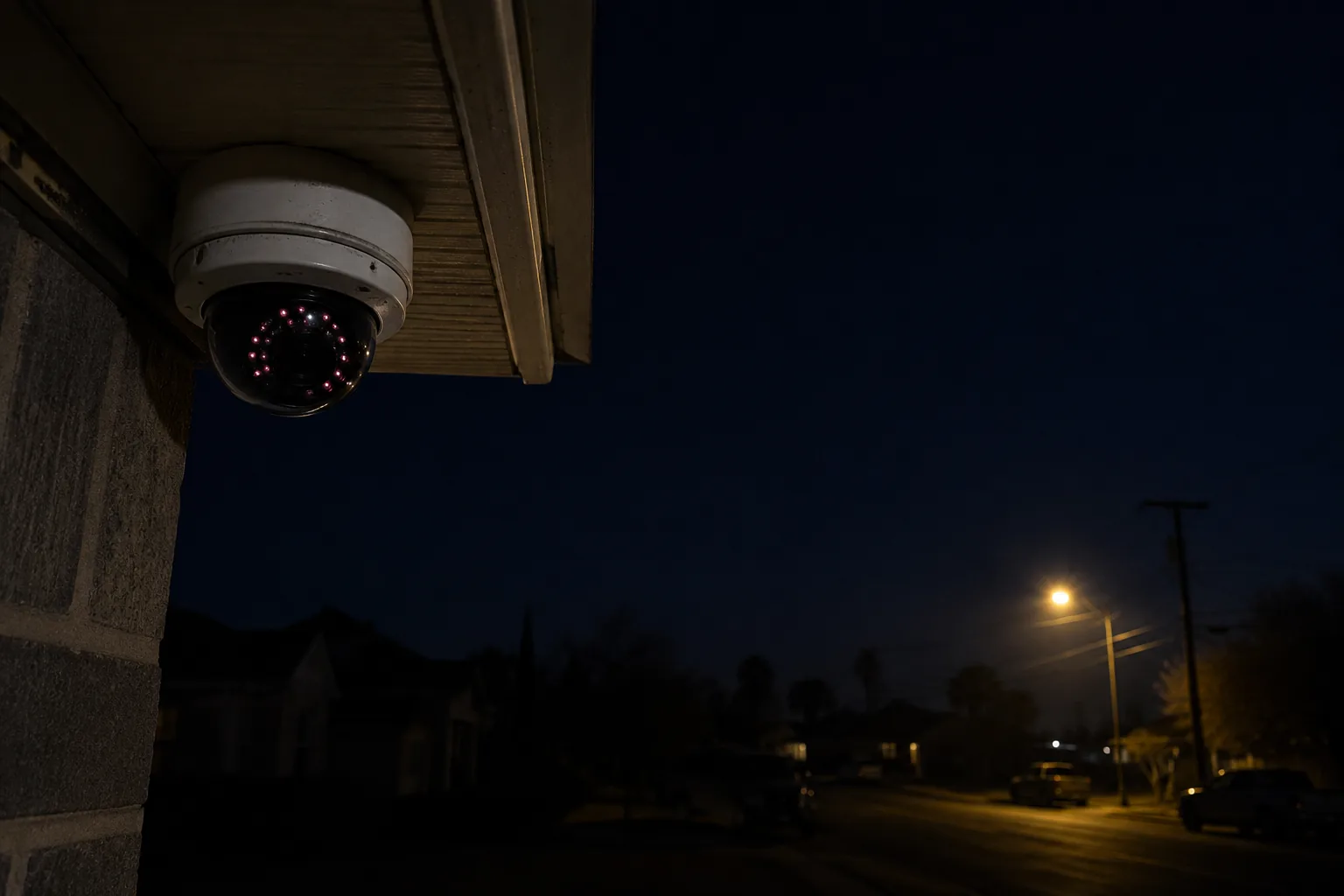
The little ring of LEDs around a camera lens is an infrared illuminator. It throws light your eye cannot see and the sensor can. It is genuinely clever engineering and it is also, functionally, a flashlight — which means it obeys every rule flashlights obey.
Chief among them is the inverse square law. Double the distance from the emitter and you get roughly a quarter of the illumination. A consumer camera advertising "100 ft night vision" is making a claim about the distance at which it can detect that something is present, not the distance at which it can tell you what. Useful identification range on most residential IR is closer to fifteen or twenty feet, and it falls off a cliff after that.
| Distance | What you get | Usable for |
|---|---|---|
| 0–8 ft | Blown-out white, often unrecognizable | Nothing — subject is overexposed |
| 8–20 ft | Clear grayscale detail, readable face | Identification |
| 20–40 ft | Recognizable shape, clothing, gait | Classification, not identification |
| 40 ft+ | Gray silhouette against noise | Confirming something moved |
Mounting height is the mistake almost everyone makes
The instinct is to mount high. It feels right — a camera at twelve feet is out of reach, out of the way, and surveys a satisfying amount of ground. Every DIY installation we are ever called out to repair has cameras mounted high.
A camera at twelve feet, angled down at a walkway, produces a beautiful high-resolution image of the top of a person's head and the tops of their shoulders. That is the whole picture. Faces are angled away from the lens by simple geometry, and no software recovers a face the camera never saw.
Identification happens between seven and nine feet of mounting height, aimed roughly level, at a point where a person walking a natural path will pass at a distance of ten to twenty feet. High enough that it cannot be knocked off a wall casually, low enough that a face fills enough of the frame to matter. That is not a compromise between competing goals — it is the single narrow band where the physics works.
Color at night beats grayscale, and it is not close
Infrared produces grayscale. Grayscale removes the single most useful descriptor available to a police report: color. "A dark sedan" describes several hundred thousand vehicles in Bexar County. "A maroon four-door with a dealer frame and damage to the right rear quarter panel" describes one.
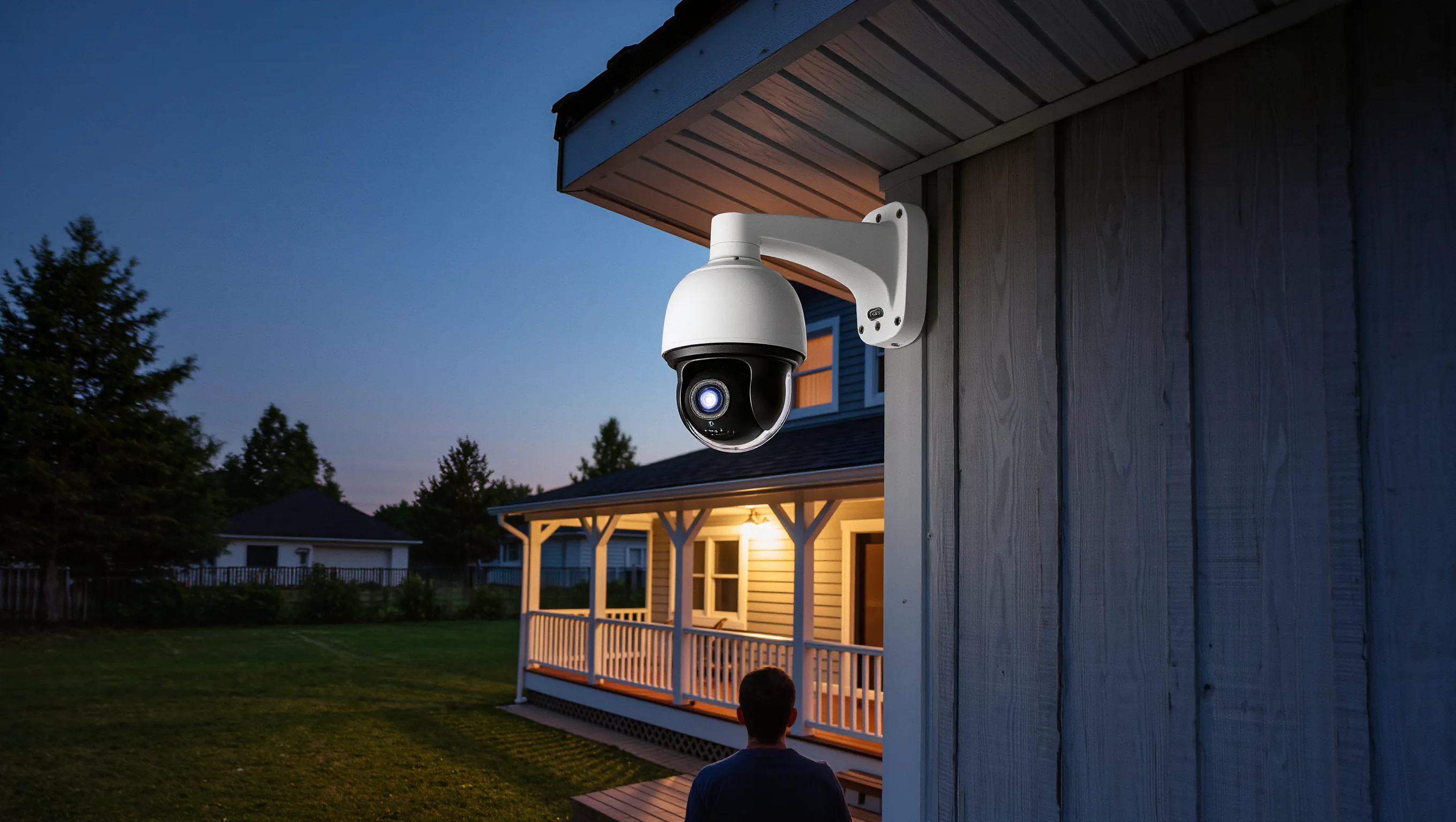
Modern low-light sensors paired with a modest spotlight produce full-color images in conditions where an IR camera would go monochrome. The spotlight is typically two to four watts — considerably less than a porch light, triggered only on motion, and bright enough to let the sensor work in color. Vehicle color, shirt color, hair color, the color of a backpack. Every one of those is a detail an investigator can actually act on.
There is a secondary benefit that is harder to measure and probably larger. A spotlight that snaps on when someone crosses a property line is an active deterrent. It says, unmistakably, that the property is instrumented and that somebody may be watching right now. A silent infrared camera says nothing at all, because the person it is recording cannot tell it exists.
A camera that records a crime is evidence. A camera that visibly notices you before the crime starts is prevention. Given the choice, take prevention.
The lighting you already have is working against you
Backlighting ruins more residential night footage than darkness does. A camera aimed at a front walk with a bright porch light behind the subject will expose for the light and render the person as a pure black cutout. The camera is not broken. It is doing exactly what it was told: average the scene, protect the highlights, and let the shadows fall.
- Never aim a camera directly at a light source — a streetlight, a porch fixture, a neighbor's floodlight, or the low winter sun at 5 p.m.
- Put the light behind or beside the camera, throwing forward onto the subject, never behind them.
- Warm-toned lighting (2700K–3000K) renders skin tones better than the harsh blue-white of most cheap security floods.
- Even, moderate light beats bright, patchy light. A camera cannot expose for a pool of glare and a black shadow in the same frame.
- Check every camera at 10 p.m., not at 2 p.m. Daytime aiming is how most night problems get installed.
Weather, and the reason your image is hazy
Two more things quietly destroy night footage, and both are correctable in under a minute.
The first is IR bounce. If the camera lens sits behind glass, or under a housing lip, or within a few inches of a wall or soffit, the infrared reflects straight back into the lens and produces a milky white haze across the whole frame. This is why a camera pointed out through a window at night sees essentially nothing, and why an otherwise good camera mounted tight under an eave washes out. Move it two inches or aim it away from the surface and the haze vanishes.
The second is spiders. This is not a joke and every installer in Texas knows it. Spiders are drawn to the warmth of IR emitters, build webs directly across the lens, and the web sits inches from a bright light source — which means it renders as a huge glowing white blur that triggers motion recording all night. A wipe every few months, or a dab of a repellent on the mount arm rather than the lens, fixes what looks like a hardware failure.
What we actually install, and why
For a typical single-family home we specify two camera roles rather than a camera count. The overview camera goes higher and wider, and its job is context: what happened, in what order, from which direction, in what vehicle. The identification camera goes at seven to nine feet, at a choke point everybody must pass — the front walk, the gate, the gap between the house and the fence — and its only job is a face.
Both get low-light sensors with spotlight-assisted color. Both get analytics configured on site rather than out of the box, with activity zones drawn to your property line so the system stops reporting the street. In Hollywood Park and Garden Ridge, that tuning session also involves deer, which will otherwise generate several hundred events a night and train you to ignore your own system inside a week.
Three to five cameras cover almost any residential property properly. If somebody is quoting you nine, ask them to walk you through what each one is for, and watch how quickly the answers become vague.
Quick answers
- What height should security cameras be mounted? +
- Seven to nine feet for cameras whose job is identifying faces, aimed roughly level rather than steeply down. Overview cameras can go higher, but a camera above about ten feet will capture the top of a head rather than a face, regardless of its resolution.
- Are 4K security cameras worth it? +
- Only after placement, lighting and mounting height are correct. A well-placed 2K camera at eight feet with color night vision will out-perform a 4K camera at twelve feet running infrared every time. Resolution multiplies a good image; it does not create one.
- Why is my camera footage white and washed out at night? +
- Almost always infrared bounce — the IR light reflecting off nearby glass, a housing lip, a wall or a soffit straight back into the lens. Moving the camera a couple of inches away from the reflecting surface usually resolves it completely. A spider web across the lens produces the same effect.
- Do security cameras work through a window? +
- Poorly at night. Infrared reflects off the glass and blinds the camera, and even with IR disabled you fight interior reflections. Exterior-mounted, weather-rated cameras are the only reliable answer.